Hospitality website design, by people
who know how rooms get sold.
Hotels, safari lodges, tented camps, game reserves and private villas each sell differently — different seasons, different trade partners, different guests. This is where those threads meet: what hospitality web work has in common, and where your property type needs something of its own.
One website, two audiences.
A hospitality website is asked to do two jobs that pull in different directions. It has to move a guest from browsing to booking, and it has to give the operators, DMCs and agents who sell your property the material they need to sell it well — rates, seasons, room and tent types, access, imagery they can use.
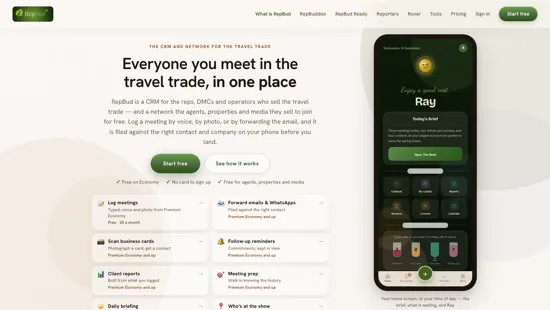
Most web agencies build for the first job and leave the second to a PDF nobody updates. Charnette Labs works across the travel trade every day, so we design for the distribution picture a property actually sits inside — the guest and the trade partner, on the same site, without either being an afterthought.
Where hospitality stops being one category.
The shared ground above is real, but it runs out quickly. A city hotel competes with the online travel agents for its own guest. A bush camp is sold months ahead through operators who need seasonal rates and airstrip detail. A private villa sells on discretion and a single decision-maker. Each has its own page here, written for that trade rather than adapted from a template.
Hotels
Winning back the guest who would otherwise arrive through an online travel agent, while keeping trade partners supplied. →
Safari Lodges & Camps
Deep seasonality, remote access and a site that has to load over satellite as well as fibre. →
Game Reserves & Conservancies
Conservation story and guest experience carried together, for properties where the land is the product. →
Villas & Residences
Whole-property bookings, discretion, and a decision made by one person rather than a booking engine. →
DMCs
If you assemble hospitality product rather than own it, the tooling problem is a different one. →
Trade Portals
A login-gated area where agents and operators pull rates, imagery and availability without emailing you. →
Rates and seasons are a design problem.
Hospitality pricing is rarely a single number. There are seasons that do not align to calendar quarters, rates that differ by market and by whether the booking arrives direct or through the trade, minimum stays that appear only at certain times of year, and child policies that vary by room type. Handed to a web agency without trade background, this usually becomes a downloadable rate sheet — which goes stale, and which no guest reads.
Treated as a design problem instead, it becomes something a guest can understand at a glance and something a trade partner can quote from with confidence. That is the difference trade fluency makes, and it is most of why properties come to us rather than to a general studio.
Common questions
What is hospitality website design?
Hospitality website design covers the websites and booking-facing tools used by properties that accommodate guests — hotels, safari lodges, tented camps, game reserves and private villas. It differs from general web design because the site carries two audiences at once: the guest booking direct, and the tour operators, DMCs and agents who sell the property on. Rates, seasons, room types and access detail have to work for both.
How is a hospitality website different from an ordinary business website?
Three things. Pricing is rarely a single number — seasons that do not follow calendar quarters, market-specific rates, minimum stays and child policies that vary by room type. Imagery is heavy, so galleries have to be built at weight or the page stalls. And the booking path has to survive a weak connection, because guests research on phones and remote properties often run on satellite or mobile data.
Do you build for hotels as well as safari lodges?
Yes. Charnette Labs works across hotels, safari lodges and tented camps, game reserves and conservancies, and private villas and residences. Each property type has its own page on this site because the distribution differs — a city hotel competes with the online travel agents for its own guest, while a bush camp is sold months ahead through operators who need seasonal rates and airstrip detail.
How much does a hospitality website cost?
A standard build (one website and one app, for iOS and Android) starts from GBP 3,000 + VAT, and hosting and care is from GBP 99 + VAT a month. Terms, conditions and usage limits apply. Until 31 December 2026, new business clients who take 12 months’ hosting and care, paid upfront, pay no build fee for one website and one app, for iOS and Android (limited to the first 25 clients or 31 December 2026, whichever comes first; a case study and testimonial are part of the offer). See the offer. Above that standard, cost varies with the number of room, tent or villa types, the seasonality detail involved, and whether trade-facing resources are included alongside the guest-facing site; larger builds are quoted after a discovery conversation, in GBP, EUR, USD or ZAR.
Can the website serve trade partners as well as guests?
Yes, and it is usually the half that gets neglected. Alongside the guest-facing site we build trade-facing resources — rate and season detail presented the way buyers read it, downloadable imagery, and where it is warranted a login-gated trade portal so agents and operators can pull what they need without emailing your team for every request.
Websites · Apps · Push notifications · Hosting & maintenance · Case study: Wildtouch Africa
Let's talk about your property.
Tell us what kind of property you run and how it reaches its guests — we will design technology that fits the way it actually sells.
Start the conversation →Prefer email? hello@charnette.io