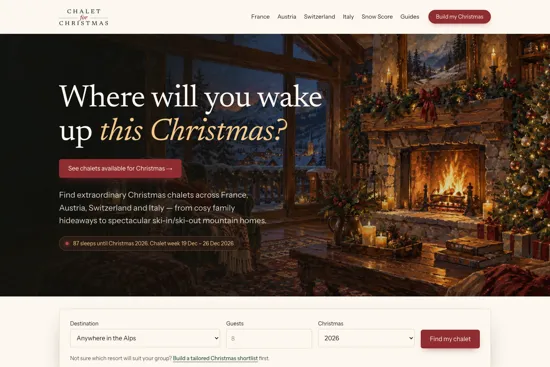
Chalet for Christmas — a guide to one week of the year.
Chalet for Christmas is our own product, not a client’s: a guide to Christmas ski chalets in France, Austria, Switzerland and Italy, built around one question — which resorts are most likely to have snow in Christmas week. We researched it, built it and publish it, and it earns a commission on some bookings made through its partner links.
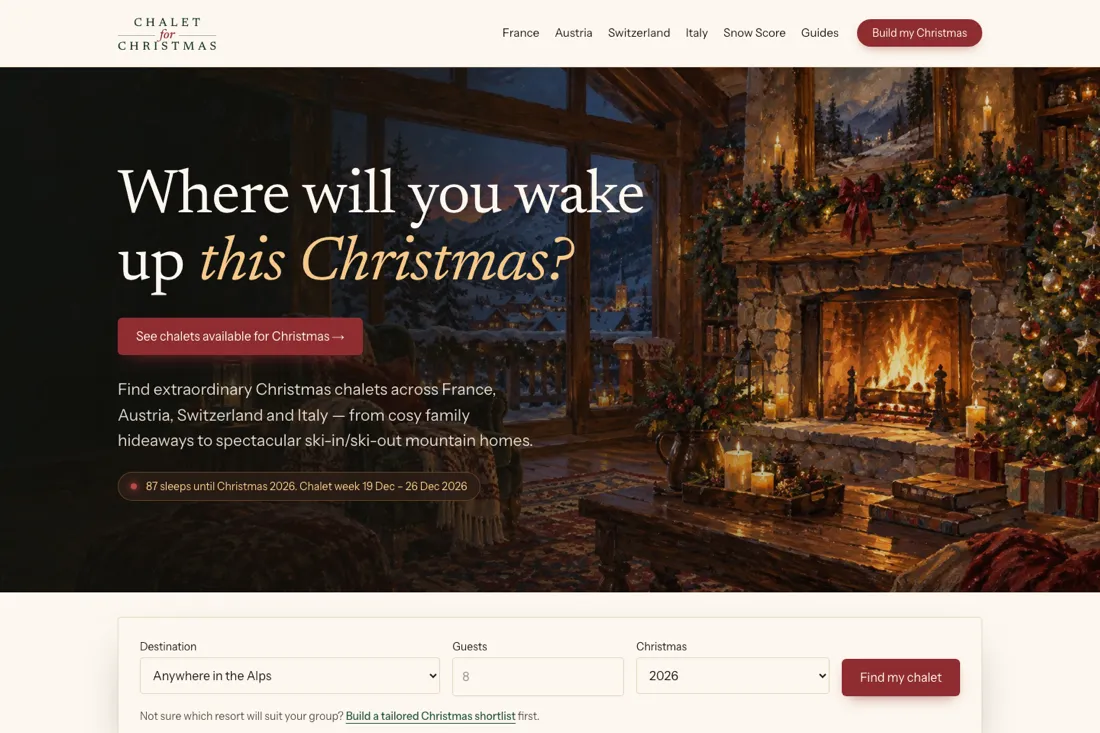
chaletforchristmas.com — Christmas ski chalets in France, Austria, Switzerland and Italy.
We built Chalet for Christmas, a guide to Christmas ski chalets across France, Austria, Switzerland and Italy, as our own product. It rates 54 Alpine resorts with a Christmas Snow Score that shows its working, publishes 1,927 measurements of snow on Christmas morning since 1996 from national and regional weather services, with the readings as CSV, and turns six questions into a shortlist of resorts with the reasons shown. It is written to be read by AI assistants as well as by people. If your tourism business depends on facts a reader can check, we can build you the same kind of site.
See how we build tourism websites → · Start a conversation →
Christmas week comes early in the season.
Christmas week falls a few weeks into the Alpine ski season, and how much snow there is in late December varies a great deal from year to year and from one resort to the next. A guide to Christmas chalets is only useful if it says which resorts have tended to have snow then, and on what evidence.
Nobody briefed us on this one, so we set the goals ourselves: a measure of Christmas snow a reader can check input by input, the measurements behind it published for anyone to reuse, and pages that search engines and AI assistants can read and cite. It earns only when a reader books through a partner link, so it has to be useful before it is anything else.
A score built on snow that was measured.
The Christmas Snow Score
A 0–100 reading of how reliably a resort tends to have skiable snow in Christmas week. 45 of the 100 points come from the measured record: how often the station serving the resort’s skiing had at least 30cm on Christmas morning, or 25 where only a village station exists. The rest is village altitude (20), top-lift altitude (15), snowmaking (12) and glacier access (8). Each resort page shows the points behind its score.
Missing is not zero
Where an input is unverified it is left out and the weights rescale across what is known; below 35% of the weight, no score is published and the page names the figure it is waiting on. Vertical range is shown but not scored: in an early version it put Val Thorens, the highest resort village in Europe, below resorts with a lower base, because it predicts terrain rather than December cover.
The Christmas Snow Report
Snow depth on the morning of 25 December at 71 weather stations in and above 52 Alpine ski resorts, each year from 1996 to 2025: 1,927 measurements by national and regional weather services, none of them modelled. Published on 21 September 2026, with each resort ranked and the worst Christmases listed.
What the measurements show
Davos, Klosters, Zermatt, Avoriaz and St Anton am Arlberg had at least 30cm on the ground on each Christmas morning measured. The worst Christmas since 1996 was 2015, when 16 of 25 slopes stations had less than 30cm. In villages below 1,400m, a white Christmas came on 79% of Christmases from 1996–2010 and 57% from 2011 onwards.
Stations chosen by rule
Each resort is matched to up to two stations: one at village height, within 6km and 300m of the village, and one at least 300m higher, within 8km, with 15 or more Christmases on record. No station is borrowed from another valley, a year with no reading is left out rather than counted as zero, and readings a provider flags as doubtful are excluded.
The data as CSV
Two downloads under CC BY 4.0: each Christmas-morning reading, one row per resort, station and year, and the Snow Score table, one row per resort. Ten data providers are credited by name and licence, from Météo-France, MeteoSwiss and the SLF to GeoSphere Austria, Meteotrentino and ARPAV, and the report gives a line to cite it by.
Build my Christmas
Six questions — where, how many guests, the budget for the week, which Christmas, ski ability and what matters most — with optional features such as a hot tub or a catered chalet. It returns a shortlist of resorts by arithmetic against our resort research, with no language model involved, shows the reasons each one scored, and the result is a link to send to the rest of the group.
Written to be read by AI
An llms.txt that opens with the Snow Report’s findings and a line to cite them by, ranks the most snow-sure resorts and explains how to read the site, and an llms-full.txt listing 551 chalets with their facts and the date each was checked. TouristDestination and FAQPage structured data on resort pages, and Dataset with DataDownload on the report and the Snow Score.
Sources, and partners disclosed
Each resort figure carries its source and the date it was checked, and the database refuses an altitude or piste figure without both. Booking links go out through one route that checks the destination against the partner’s own allow-list, are marked as sponsored, and the commission from Booking.com, Expedia, Skiworld and Kiwi.com is disclosed on each page.
A guide that shows its working.
Chalet for Christmas covers 54 Alpine resorts, all of them carrying a Christmas Snow Score, and 551 chalets across 823 URLs. The Christmas Snow Report was published on 21 September 2026 and is refreshed each January, once that Christmas has been measured. Christmas 2026 is the season it was built for, so it is too early to report traffic or bookings, and we don’t. What it shows today is the method: a score that names its inputs, measurements in place of estimates, and the data published for others to check and reuse.
Next.js 16 on the App Router, in TypeScript with Tailwind, hosted on Vercel, with the resorts, chalets and snow records in Supabase. The app holds only Supabase’s publishable key, and row-level security decides what it can read and write. The score is calculated in one place, so the stored score and the one on the page cannot drift apart. URLs carry no year, so a page keeps its address from one Christmas to the next, and a test enforces it; the test suite also covers the season logic, the Snow Score, the booking links, the redirect’s allow-list and the Build my Christmas matching. A daily job stores the latest readings from Météo-France, GeoSphere Austria, MeteoSwiss and the SLF for a page on snow in the Alps now.
Chalet for Christmas, answered
What is Chalet for Christmas?
Chalet for Christmas is an independent guide to Christmas ski chalets in France, Austria, Switzerland and Italy, at chaletforchristmas.com. It is Charnette Labs’ own product rather than a client build: we researched it, built it and publish it. It covers 54 Alpine resorts, each with a Christmas Snow Score, and 551 chalets from booking partners, and it earns a commission on some bookings made through its links.
How is the Christmas Snow Score worked out?
It is a 0–100 reading of how reliably a resort tends to have skiable snow in Christmas week. 45 of the 100 points come from the measured record: how often the weather station serving the resort’s skiing had at least 30cm on the ground on Christmas morning (25 points where only a village station exists). The rest is village altitude (20), top-lift altitude (15), snowmaking coverage (12) and glacier access (8). A missing figure is left out and the weights rescale; below 35% of the weight, no score is published. It is not a forecast, and no resort can guarantee snow in a given week.
Where does the Christmas snow data come from?
From national and regional weather services, not a model. The Christmas Snow Report reads snow depth on the morning of 25 December at 71 weather stations in and above 52 Alpine ski resorts, each year from 1996 to 2025: 1,927 measurements from providers including Météo-France, MeteoSwiss, the SLF, GeoSphere Austria, Meteotrentino and the Province of Bolzano. Each reading is published as a CSV, one row per resort, station and year, under CC BY 4.0.
Can Charnette Labs build a guide or data-led site like this for us?
Yes. We build websites for tourism businesses, from tour operators and accommodation to tourist boards, and the sourcing, published data and structured data behind Chalet for Christmas carry over to any site whose readers need to check the facts. See charnette.io/websites and charnette.io/tourist-boards, or start a conversation at charnette.io/contact.
Show the working behind your numbers.
Measured, sourced and built to be read by travellers, search engines and AI assistants.
Start the conversation →Prefer email? hello@charnette.io