Praslin & La Digue — a guide that leaves the gaps empty.
Our own product, not a client’s: an independent guide to staying on the two Seychelles islands most people pair with Mahé. We researched it, built it and publish it, and it earns through Booking.com affiliate links. It went live on 18 September 2026 and runs to 465 pages, none of which shows a photograph of a property we have not been given one for.
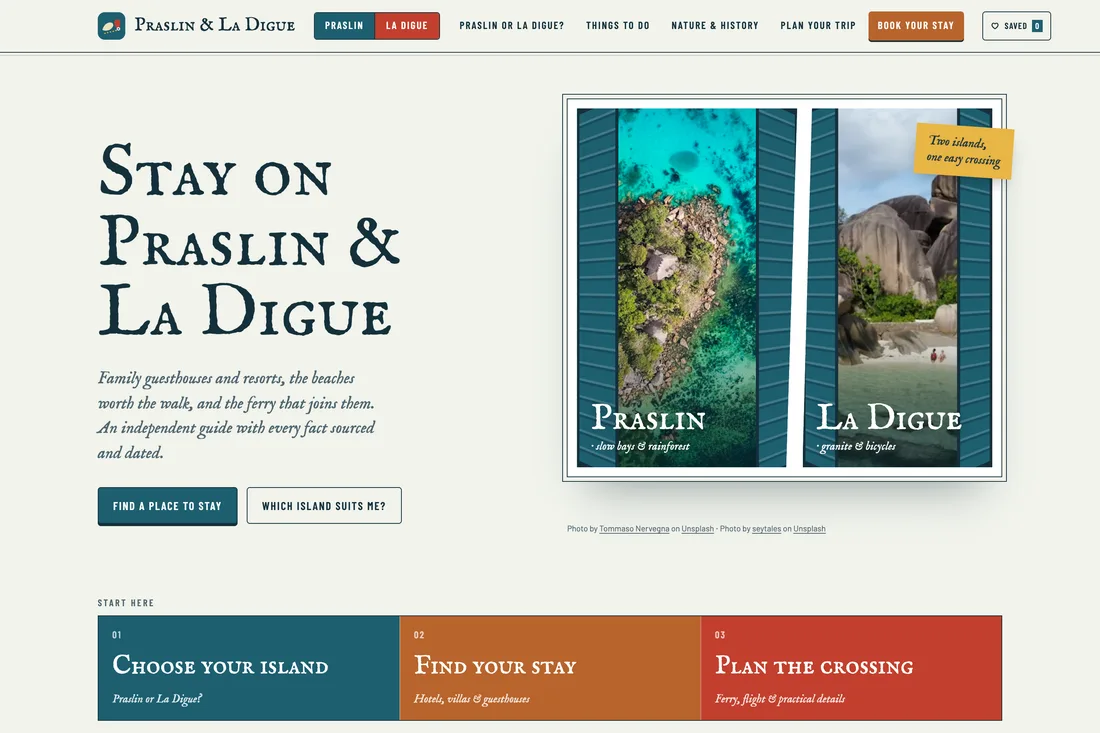
praslinladigue.com — live and indexable since 18 September 2026.
Two islands, and one crossing between them.
Almost nobody goes to the Seychelles for one island. They fly into Mahé and then choose between Praslin, which has the airport and the long beaches, and La Digue, which has no airport, granite boulders and bicycles. The question a traveller actually has is not which hotel but which island, and then which bay on it — because on La Digue the difference between the west coast and the east coast is the difference between a swim and a warning sign.
Nobody briefed us on this one, so we set the goals ourselves: a guide a reader can check rather than take on trust, every fact carrying its source and the date it was checked, and pages that search engines and AI assistants can read and quote. It earns only when a reader books through one of its links, so it has to be worth reading first.
A guide that shows what it does not know.
Creole Chart
The design is a creole house drawn on a nautical chart: shutters, postcards and luggage tags in chart paper, depth blues and sand, teal for Praslin and buoy red for La Digue. Every listing card carries a chart of the island with the place marked on it, so a reader sees where somewhere is before reading a word about it.
261 places to stay, 182 bookable
Every published place to stay across both islands, with its type, area, facilities, room count where it is on record and its distance from the jetty in a straight line. 182 carry a property-specific Booking.com link traced to the listing it points at; the other 79 say so rather than sending a reader somewhere approximate.
2,520 sources, cited 4,259 times
A rating, a price or an opening time is stored only with its source, that source’s URL and the date it was checked — the database refuses it otherwise. Each page lists what it was built from and when that was last looked at, so a reader can go and check rather than take our word for it.
No photographs we were not given
Not one of the 261 places to stay has a photograph on the site, because we have no cleared photograph of any of them. Rather than dress the pages with stock beach scenes, a card shows a chart of where the place is. It is the least flattering decision on the site and the one we would defend hardest.
Beaches, not “hotels in”
We checked demand before writing. Three months of search impressions put the beach names far ahead of the commercial phrasings — 34,700 for the granite boulders at Anse Source d’Argent and 18,500 for Anse Lazio, while “praslin hotels” and “where to stay praslin” returned too little data to report. So the beaches carry the guide, and the places to stay sit beside them.
Built to be quoted
All 465 pages carry structured data naming what the page is about, and the site publishes an llms.txt index alongside a 204 KB llms-full.txt holding every place with its facts. GPTBot, ClaudeBot, PerplexityBot, OAI-SearchBot and Google-Extended are allowed by name in robots.txt rather than left to guess.
Measured on a phone, not assumed.
A guide is no use if it will not load on the phone someone is reading it on at the ferry terminal. We measure it the way Google does — a 393-pixel screen, a four-times slower processor and a slow 4G connection — against the live site, three runs a page, and act on what comes back rather than on how it feels on a laptop.
The biggest saving came from a fault worth naming. Each listing card drew the island’s whole coastline inside itself, so the Praslin “where to stay” page carried 154 copies of the same drawing: 6.75 MB of markup and 12,621 elements for the phone to lay out. Compression hid it on the way down, which is why it went unnoticed. The drawing is now written once per page and referenced, and the page is 836 KB.
What we are not claiming yet.
The guide has been open to search engines since 18 September 2026. Every event the site records so far arrived with no referring site, which means the visitors are us, testing. There have been no bookings, and we are not going to dress up a number that has not happened. What exists today is the guide itself, the evidence under it and the measurements above; the traffic is the next thing to find out, not something to claim in advance.
Praslin & La Digue, answered
What is praslinladigue.com?
It is an independent guide to staying on Praslin and La Digue in the Seychelles, at praslinladigue.com. It is Charnette Labs’ own product rather than a client build: we researched it, built it and publish it. It covers 261 places to stay, 64 places to eat and drink, 36 beach guides, 33 things to do and 99 operators across 465 pages, and it earns through Booking.com affiliate links.
Why are there no photographs of the hotels?
Because we have not been given one for any of them, and we will not put a stock beach scene beside a named guesthouse as though it were a picture of that guesthouse. Every listing card shows a chart of the island with the place marked instead. When an owner gives us a photograph of their own property we will use it, credited.
How do you know the places listed are still trading?
A place is published only with dated 2025–26 evidence that it is trading — a tourism board record created or updated, an owner’s site carrying current rates, or dated reviews. A register entry on its own is not enough. 2,520 sources are cited 4,259 times across the guide, and anything that fails the test is held back rather than published with a hopeful note. On the last count 50 places to stay and 56 places to eat were being held for exactly that reason.
Can Charnette Labs build a guide or destination site like this for us?
Yes. We build websites for tourism businesses, from tour operators and accommodation to tourist boards, and the research, sourcing, structured data and performance work behind Praslin & La Digue carry over to any site that depends on getting its facts right. See charnette.io/websites and charnette.io/tourist-boards, or start a conversation at charnette.io/contact.
Publish facts your readers can check.
If your website lives or dies on the details being right, we build that way as a matter of course. The first call is free, and you will not spend it explaining the tourism trade.
Talk to Graeme →