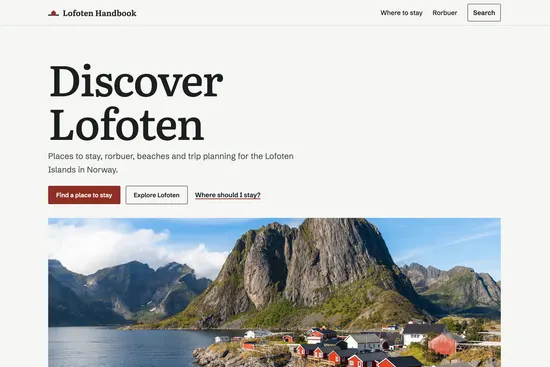
Lofoten Handbook — a travel guide that shows its sources.
Lofoten Handbook is our own product, not a client’s: an independent English-language guide to where to stay in the Lofoten Islands, Norway. We researched it, built it and publish it, and it earns through Booking.com affiliate links. It went live on 16 September 2026.
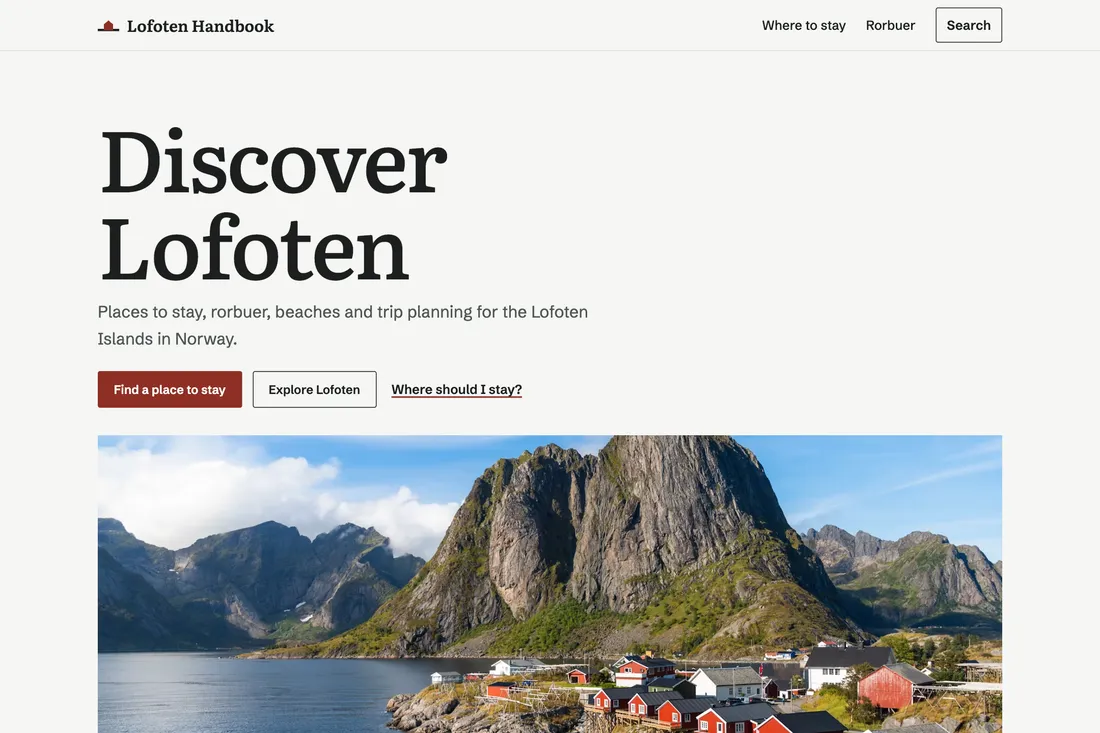
lofotenhandbook.com — live since 16 September 2026.
Where to stay is a question of where.
Lofoten’s villages sit along one road, the E10, with some of them at the end of side roads off it. Choosing a base is less about the room than about the place: how far it is from the ferry, the trailhead or the next village, and whether the details a traveller is relying on are still current.
Nobody briefed us on this one, so we set the goals ourselves: a guide a reader can check rather than take on trust, research at a scale one writer could not keep up with, and pages that search engines and AI assistants can read and cite. It earns only when a reader books through one of its links, so it has to be useful first.
A guide built on claims that were checked.
The Chain
The design lays Lofoten out as one line of places along the E10, from Svolvær in the north-east to Å where the road ends, with side-road villages such as Henningsvær, Ballstad and Nusfjord hanging off it. A reader sees where a base sits before reading a word about it.
14 places, 85 places to stay
A guide to each of the 14 places on the chain, 85 places to stay from rorbuer to hotels, 18 beaches, 21 things to do and 8 itineraries — 190 URLs by the end of launch day. Planning guides cover getting there, ferries, car hire and the seasons, with FAQs on the planning, beach, activity and itinerary pages.
Sources on the page
Each guide page lists its sources and the date its details were last verified. Where a fact could not be established, the field stays blank rather than holding a guess.
A 25-agent research pass
Parallel AI research agents built 12 datasets and checked 1,101 claims against sources fetched again for the check. 84% held as first written; the rest were corrected or removed.
A second pass on the live copy
Once the pages were written, the published copy was checked again: 138 claims on the destination and landing pages, and 844 claims across 36 property pages.
Booking links that lead somewhere
Booking.com’s server returns HTTP 202 even for a made-up hotel URL, so a status check proves nothing. Each listing was opened in a real browser and matched by property name and address — 84 of the 97 properties researched had one.
Affiliate income, disclosed
The guide earns through Booking.com affiliate links via CJ. A label beside the booking button says so, a disclosure page explains how it works, and a property with no listing links to its own website instead.
Legible to search and AI
Organization, WebSite, TouristDestination, LodgingBusiness and ItemList structured data, FAQPage where a page has FAQs, and an llms.txt and llms-full.txt. IndexNow, Google Search Console and Bing Webmaster Tools were set up on launch day.
Fast on a phone
On a throttled mobile test the homepage hero’s LCP came down from 2.4–2.6 s to a median of 2.1 s once the display font preload was cut from 110 KB to 39 KB. PageSpeed Insights scored the mobile homepage 93–96 for performance and 100 for accessibility, best practices and SEO.
A guide that shows its working.
Lofoten Handbook went live at lofotenhandbook.com on 16 September 2026, with 190 URLs in its sitemap by the end of launch day. It is too early to report traffic or bookings, so we don’t. What it shows today is the method: research run in parallel by agents, claims checked against sources fetched again for the purpose, and those sources left on the page for the reader to see.
Next.js 16 on the App Router, hosted on Vercel, with the guide’s content in Supabase. Row-level security is switched on for each table, and the app holds no service-role key. Performance was measured on a throttled mobile profile (412 px, 150 ms RTT, 1.6 Mbps, 4x CPU) rather than on a desktop connection, and Lighthouse was run through PageSpeed Insights on launch day.
Tourism websites · Tourist board websites · Getting found in AI search · Kusa Connect case study · More of our work
Lofoten Handbook, answered
What is Lofoten Handbook?
Lofoten Handbook is an independent English-language guide to where to stay in the Lofoten Islands, Norway, at lofotenhandbook.com. It is Charnette Labs’ own product rather than a client build: we researched it, built it and publish it. On launch day it covered 14 places along the E10 from Svolvær to Å, 85 places to stay, 18 beaches, 21 things to do and 8 itineraries, and it earns through Booking.com affiliate links.
How do you check the facts in a guide researched by AI agents?
By treating each claim as something to check against a source rather than something to publish. For Lofoten Handbook a 25-agent research pass checked 1,101 claims against sources fetched again for the check; 84% held as first written and the rest were corrected or removed. The live copy was then checked a second time, and each guide page lists its sources and the date its details were last verified.
Why confirm Booking.com links in a real browser?
Because the status code cannot be trusted. Booking.com’s server returns HTTP 202 even for a hotel URL that does not exist, so a link checker reports a made-up listing as fine. Each Lofoten Handbook listing was opened in a real browser and matched by property name and address; 84 of the 97 properties researched had a matching listing.
Can Charnette Labs build a guide or destination site like this for us?
Yes. We build websites for tourism businesses, from tour operators and accommodation to tourist boards, and the research, sourcing and structured data behind Lofoten Handbook carry over to any site that depends on getting its facts right. See charnette.io/websites and charnette.io/tourist-boards, or start a conversation at charnette.io/contact.
Publish facts your readers can check.
Researched, sourced and built to be read by travellers, search engines and AI assistants.
Start the conversation →Prefer email? hello@charnette.io